The Line Through Leadership Data
You are told there is a gap. You sense a different one. The feedback contradicts itself, and your own read on your performance may be the least reliable data of all. This is about the line between the signals a leader can trust and the ones you cannot, and how to get on the right side of it.
Joanne Miranda, MBA, SCPC · Founder, Tessadi · 12 July 2026 · 8 min read
In more than twenty years advising executives and coaching leaders through succession, transformation and the occasional quiet crisis, the problem I meet most often is not incompetence. It is confusion. A capable leader is handed three readings of the same gap, from the board, from a 360 report, from their own instinct, and none of them agree. The hardest part of leading well is often just working out which signal to believe.
Three leaders, one problem
Consider three leaders you might recognise, perhaps from your own week.
Daniel has just been told by his board that he has a gap in strategic influence. He is blindsided. Every number delivered, every instrument positive, and now a gap he cannot see.
Sarah senses something is wrong in how she is running her team. Yet her latest 360 came back warm and reassuring. Her instinct says one thing, the feedback says another.
Michael built his career on decisiveness in a stable market. The market is no longer stable, and the behaviours that made him successful may now be working against him.
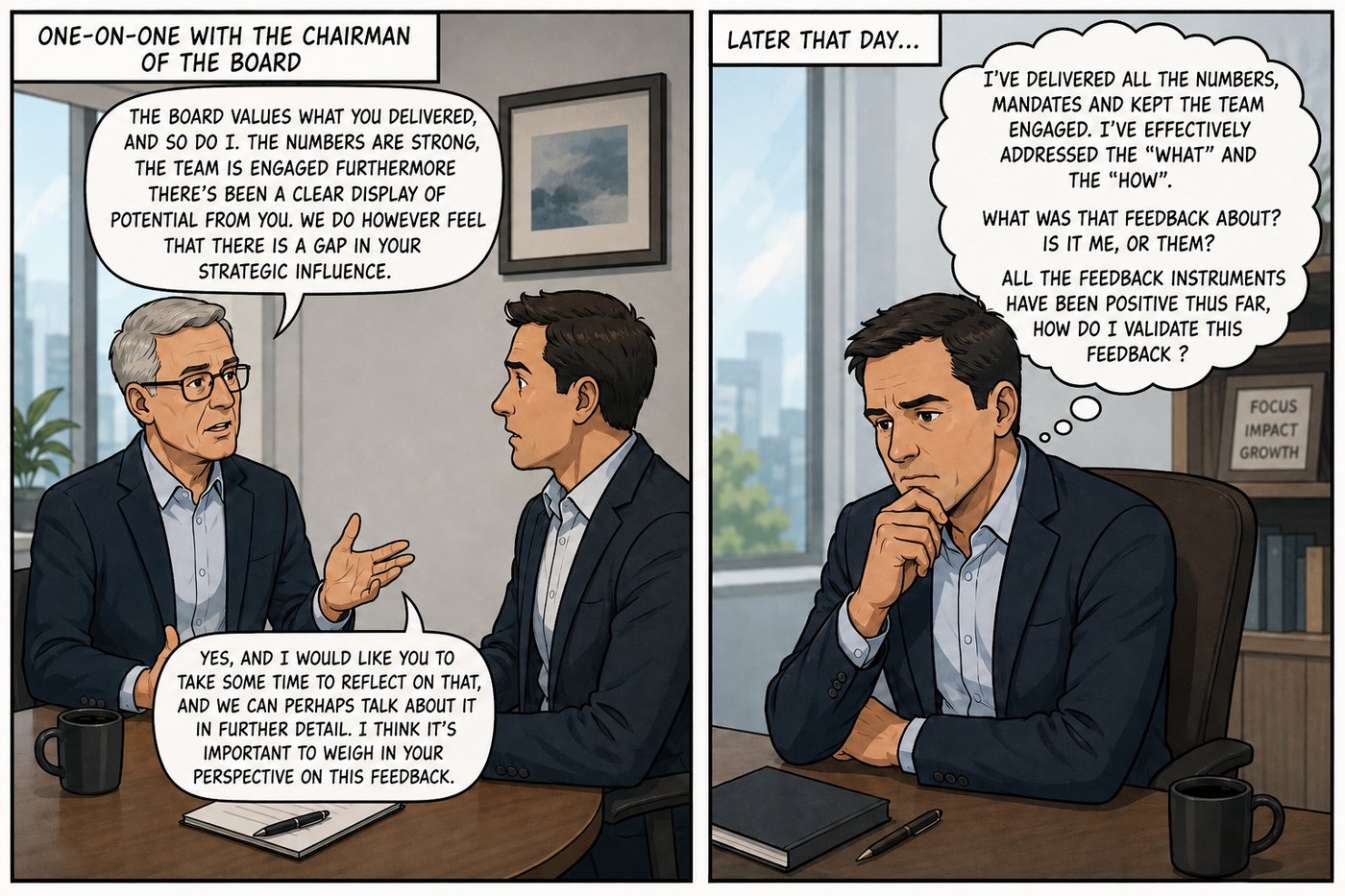 Daniel. Informed by the board he has a gap he cannot see.
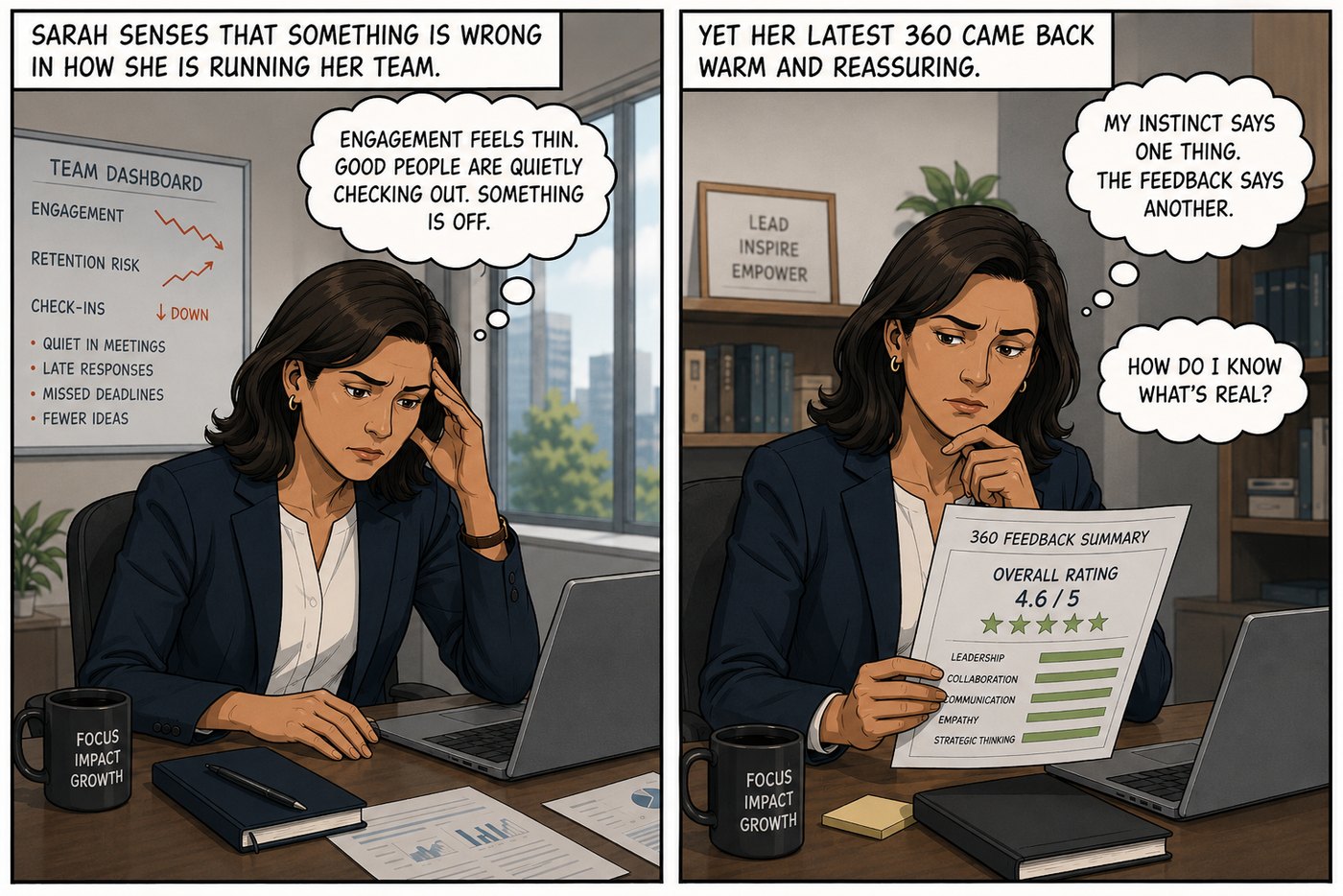 Sarah. Her instincts indicate that all may not be well, even though the leadership measurement instruments state otherwise.
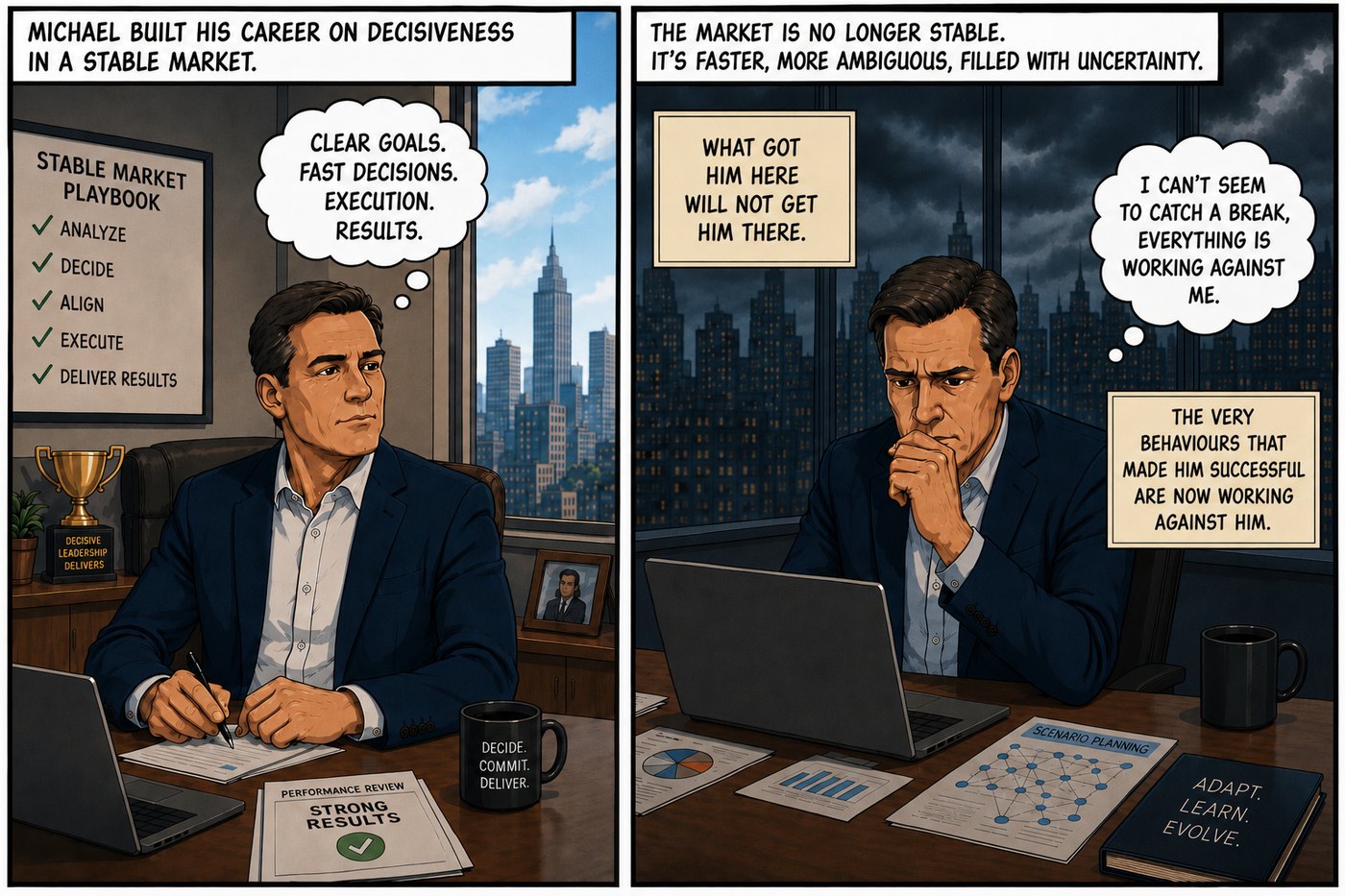 Michael. The strengths that built his career now work against him.
Three situations, one shared predicament. Each leader is trying to reconcile what others say about them with what they believe about themselves, and neither source is solid enough to act on with confidence. This is the daily reality of leadership, and it is where the trouble starts.
And it does not stay personal. A leader's blind spots do not stop at the office door. Gallup's analysis of 2.7 million employees found that managers alone account for roughly 70 percent of the variance in their team's engagement (Gallup, 2015), and engagement in turn tracks with productivity, retention and profitability. A leader who doubts the wrong things, or is blind to the right ones, is not carrying that uncertainty alone. It is quietly priced into the performance of everyone they lead. For the organisation, unclear leaders are expensive in ways that never show up on a single line of the budget, which is precisely why the person reading this is rarely deciding only for themselves. Leaders are the organisation's instrument for reading other leaders too.
There is a line running through leadership data
Every piece of information you hold about your own leadership, or anyone's, sits on one side of a line. Below the line is what people say: the board's read, the 360, the references, and the leader's own self-assessment. Above the line is what a person demonstrably does, their behaviour, observed directly and measured against a standard. The distinction sounds academic until you are Daniel, Sarah or Michael, or until you are the one deciding their future. Then it is everything, because below the line you are navigating by opinion, including your own, and above it you finally have a signal you can trust.
Why you cannot fully trust the feedback, or your own read
Start with the uncomfortable part: a person's view of themselves is a weak instrument. When researchers compared self-assessments of ability against objective measures of performance across 55 studies, the average correlation was only about r = .29 (Mabe and West, 1982), a faint signal to steer a career, or a succession decision, by. And it is not random noise. Leaders whose self-view lines up with how others actually see them tend to perform better, while those who over-rate themselves, the ones with the largest blind spots, tend to perform worse (Atwater and Yammarino, 1992). Self-awareness is not a soft virtue. It is a measurable performance variable.
The external feedback is not much firmer. Multisource, or 360, feedback is useful, but on its own it rarely changes behaviour: the most cited meta-analysis found the average improvement afterwards is small (Smither, London and Reilly, 2005). Feedback tells Sarah she is doing fine while her instinct says otherwise. It tells Daniel he has a gap without telling him what, specifically, he does that creates it. Both are left holding opinions.
Below the line, you learn what people believe about a leader, including what the leader believes about themselves. Above it, you learn what they actually do.
I did not always think this way. For a long stretch of my career I treated a well-run 360 as the closest thing to truth we had. What changed my mind was not a study. It was watching capable leaders nod along to warm feedback and then, a few weeks later, do the exact thing the feedback swore they did not. Feedback describes a leader. It rarely tests one.
As a coach, this is the knot I untie most often. A leader arrives with a fistful of contradictory feedback and a self-image that may or may not be accurate, and the first, most expensive weeks go on simply establishing what is true. Coaching works, and a systematic review of 117 studies identified seven factors that shape whether it works, among them the coachee's motivation and goal orientation, the trust in the relationship, and how feedback is handled (Bozer and Jones, 2018). But it works far faster when it starts from an objective picture of behaviour rather than a negotiation between competing opinions.
And this is not a small or cheap problem for the organisations paying for it. Executive and business coaching is now a multi-billion dollar industry, on the order of 4.5 billion US dollars a year worldwide and growing fast (ICF Global Coaching Study, 2023). Yet the organisations that fund it routinely struggle to prove what they bought, because coaching's return is famously hard to measure. Part of the reason sits exactly here: when coaching begins from contested feedback and a leader's own uncertain self-image rather than from an objective read of behaviour, there is no clean baseline to measure change against. Organisations are buying development without a diagnostic.
What you can trust, and how it helps you grow
Above the line is harder to reach, which is why it is rare. It means observing what a leader actually does, in conditions realistic enough to matter, and scoring that behaviour to a consistent standard. Here I want to be precise, because the claim is easy to overstate. The evidence does not say behavioural methods are better in some general sense. It says that for predicting how a leader will actually perform, structured, behaviour-based methods such as assessment simulations do markedly better than self-report, with meta-analytic validity around r = .37 for assessment centres (Gaugler and colleagues, 1987). Better at prediction. Not automatically better for every purpose, and not a crystal ball.
An example, lightly disguised. Some years ago I worked with a manufacturing executive who was superb with numbers and certain that his team's problems belonged to the team. His 360 was, if anything, generous. We put him through a series of decision simulations, and the same small moment kept repeating: under pressure he shut down disagreement within seconds, then moved on convinced he had heard everyone out. He had argued with every piece of feedback he had ever been given. He did not argue with the footage. That is the difference an objective read makes. Not that it is kinder, but that it is harder to dismiss.
The same holds for our three leaders. Objective evidence would give Daniel something specific to work on instead of a label he resents, tell Sarah whether her instinct about her team is right or wrong, and show Michael which of his old reflexes still fit a world that has moved. In each case the evidence does not make the decision. It stops them guessing.
It also compounds. Because a leader sets the weather for everyone beneath them, the return on one leader seeing clearly does not stay with that leader; it spreads across a team, and up through every succession and hiring call they will make. An objective read of behaviour is as much a development tool as a diagnostic one, and as much an organisational asset as a personal one. Evidence is what turns self-doubt into a plan.
Why now
The timing is not incidental. Organisations pour enormous sums into developing and selecting leaders, roughly 400 billion US dollars a year in corporate learning alone (The Josh Bersin Company, 2026), yet most employers still name leadership and skills gaps as a major barrier to transformation (World Economic Forum, 2025). The money proves the intent. The persistent gaps prove that the measurement underneath it has not kept pace. In a world changing as quickly as Michael's, steering development, your own or your organisation's, by opinion is a slower and riskier bet than it has ever been.
Where the evidence stops
None of this makes behavioural measurement perfect, and it would be dishonest to imply otherwise. A simulation is not the job; it is a good proxy, not a replica. Observation can carry its own biases, in the scenario, the scoring, or the observer. Being measured changes behaviour, so part of what you see is a response to being watched. And some of the most effective leaders I have known deliberately break the very norms a model would mark them down for, at exactly the right moment. Evidence of behaviour is the strongest starting point we have for a hard decision. It is a starting point, not a verdict. The judgement still belongs to people.
An honest mirror
One honesty, so the claim is clean. Measuring leadership from behaviour is a discipline still being built, and the instruments that do it, including ours, have to earn their authority through validation against recognised standards, over time. This is a mirror, not a verdict on anyone's worth, and a good mirror is candid about its own making. The line is not our invention. It is just where the honest evidence sits. What we are trying to do is make that side easier to reach, for the leader who wants an accurate look at themselves, the coach beside them, and the board deciding their future. In my experience the leaders who get there first are rarely the most certain ones. They are the ones curious enough to want to know.
References
- Mabe, P. A., & West, S. G. (1982). Validity of self-evaluation of ability: a review and meta-analysis. Journal of Applied Psychology, 67, 280-296.
- Atwater, L. E., & Yammarino, F. J. (1992). Does self-other agreement on leadership perceptions moderate the validity of leadership and performance predictions? Personnel Psychology, 45, 141-164.
- Smither, J. W., London, M., & Reilly, R. R. (2005). Does performance improve following multisource feedback? Personnel Psychology, 58, 33-66.
- Gaugler, B. B., Rosenthal, D. B., Thornton, G. C., & Bentson, C. (1987). Meta-analysis of assessment center validity. Journal of Applied Psychology, 72, 493-511.
- Gallup (2015). State of the American Manager. Managers account for roughly 70 percent of the variance in team engagement.
- International Coaching Federation (2023). ICF Global Coaching Study. Global coaching revenue estimated at 4.56 billion US dollars, up 60 percent since 2019.
- Bozer, G., & Jones, R. J. (2018). Understanding the factors that determine workplace coaching effectiveness: a systematic literature review. European Journal of Work and Organizational Psychology, 27(3), 342-361.
- The Josh Bersin Company (2026). AI is disrupting the 400 billion dollar corporate training market.
- World Economic Forum (2025). Future of Jobs Report 2025.
Joanne Miranda is the Founder of Tessadi, an AI startup pioneering evidence-based leadership intelligence, and a global HR leader with more than 20 years advising C-suite teams across Fortune 500 organisations in APAC, EMEA and the US. Her career has centred on the people decisions behind enterprise value, encompassing leadership succession, executive performance and organisational readiness across large-scale workforce transformation and full-cycle M&A. That work extended into HR digitalisation, where she laid the foundations for AI-driven workforce analytics. Today, through Tessadi and its simulation-based platform Veridessa, she is redefining how organisations measure leadership: assessing capability from observed behaviour rather than self-report. She holds an MBA in Strategic Management from the University of Strathclyde and is a Senior Certified Professional Coach.
See how Veridessa turns behaviour into evidence.
Tessadi is building Veridessa, an instrument that measures leadership capability from observed behaviour. If the thinking resonates, the conversation is better.
Explore VeridessaStart a Conversation